


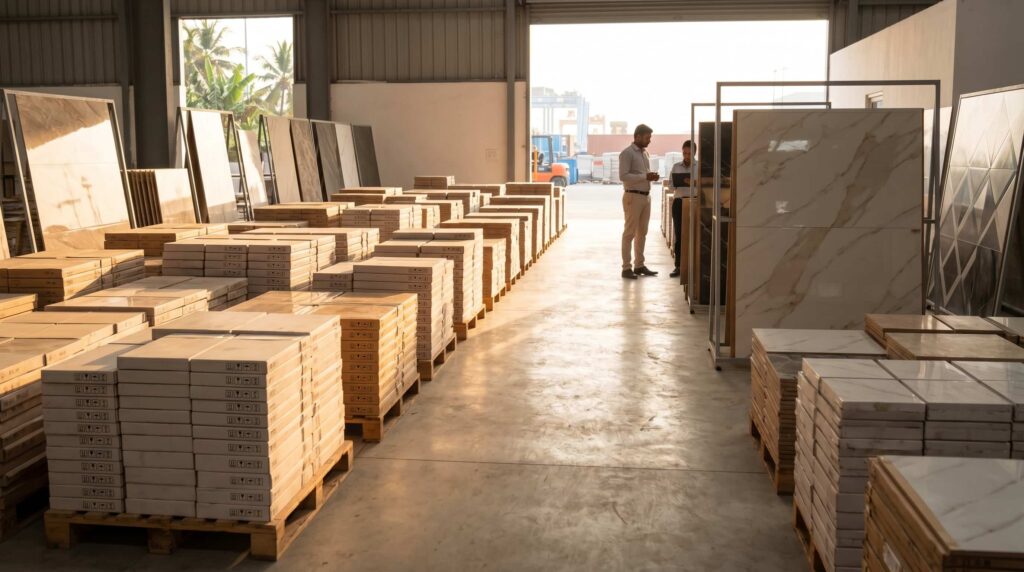
India’s ceramic tile industry has gone through a remarkable transformation over the past few decades. What started as a small, craft-based sector has grown into one of the most powerful manufacturing ecosystems in the world. Today, India is the second-largest producer and exporter of ceramic tiles globally, exporting approximately 589 million square metres of tiles annually to over 150 countries.
This growth did not happen overnight. It is the result of smart manufacturing investment, abundant raw materials, strong government support, and a relentless focus on quality and design innovation. For global buyers, importers, and developers, Indian ceramic tiles now represent a combination of quality, variety, and value that very few countries can match.
Evolution of India’s Ceramic Tile Industry
From Traditional Craft to Industrial Powerhouse
India has a long history of working with clay and natural minerals. Traditional pottery and terracotta crafts laid the foundation for what would eventually become one of the world’s most productive tile manufacturing industries. Through the 1980s and 1990s, small workshops began transitioning into organised production units, adopting kiln technology and mechanised processes that significantly increased output and quality.
By the 2000s, Indian tile manufacturers had invested heavily in Italian and Spanish production technology, transforming the sector from basic domestic supply to internationally competitive export manufacturing.
Rise of Manufacturing Clusters: The Morbi Model
The single most important factor in India’s tile industry growth is Morbi, a city in Gujarat that produces approximately 90% of India’s entire ceramic tile output. Morbi developed as a cluster-based manufacturing hub where hundreds of small and medium enterprises operate in close proximity, sharing infrastructure, supply chains, logistics networks, and skilled labor pools.
This cluster model drives down production costs, accelerates technology adoption, and creates the scale needed to fulfill large international orders. Morbi alone is home to over 700 tile manufacturing units, making it one of the most concentrated industrial zones in the global tile industry.
Key Factors Behind India’s Manufacturing Dominance
Cost-Effective Production
India’s manufacturing cost structure is highly competitive. Lower labor costs, affordable land, and economies of scale from cluster-based production enable Indian manufacturers to produce high-quality tiles at prices that European and Chinese competitors struggle to match. These savings are passed directly to international buyers, making Indian tiles an attractive proposition for bulk importers and large-scale project procurement teams.
Abundant Raw Materials
India has large domestic reserves of the key raw materials used in ceramic tile production, including clay, feldspar, silica, and quartz. Easy access to these materials reduces input costs and ensures supply chain stability, giving Indian manufacturers a natural advantage over countries that rely on imported raw materials for production.
Government Support and Policies
The Indian government has actively supported the growth of the ceramic tile industry through its Make in India initiative, export promotion schemes, infrastructure investment, and financial incentives for manufacturing clusters. These policies have encouraged both domestic expansion and international competitiveness, helping Indian tile manufacturers access new export markets and invest in production upgrades.
Technological Advancements
Indian tile manufacturers, particularly those in Morbi, have invested significantly in modern production technology. Digital inkjet printing systems now allow manufacturers to produce photorealistic tile designs that replicate marble, stone, wood, and concrete with precision. Automated pressing systems, precision kiln technology, and AI-driven quality control processes have raised production standards across the industry. Smart factory concepts are increasingly being adopted by leading manufacturers, improving efficiency, reducing waste, and enabling more consistent product quality at scale.
India’s Strong Position in the Global Tile Market
India’s tile export volumes have grown dramatically, rising from approximately 55 million square metres in 2013 to around 589 million square metres in 2023. This growth reflects both the expansion of Indian manufacturing capacity and the increasing preference of global buyers for Indian-sourced tiles.
The rise of ceramic tiles export from India has been particularly strong across the Middle East, Africa, Europe, Southeast Asia, and the Americas, with buyers in these regions increasingly recognising Indian manufacturers as reliable, quality-driven partners for large-scale procurement. The Middle East and Africa remain the largest export markets, while growth in Europe and North America is accelerating as buyers diversify away from China-dependent sourcing strategies.
India’s competitive pricing, combined with improving product quality and design capability, has made it the second-largest ceramic tile exporter in the world, behind only China.
Why Indian Tiles Are Dominating the Global Market
Design Innovation and Variety
Indian ceramic tile manufacturers now offer product ranges that rival the design sophistication of European manufacturers. Large-format slabs, premium marble-look collections, wood-look plank tiles, concrete and industrial finishes, and customised designer patterns are all produced at scale by leading Indian manufacturers. This design versatility allows global buyers to source tiles for every project requirement from a single country of origin.
High Quality and International Standards
Leading Indian manufacturers hold ISO certifications and comply with EN and ASTM international standards for ceramic and porcelain tiles. These certifications validate product performance in water absorption, breaking strength, surface hardness, and dimensional accuracy, giving international buyers confidence in compliance with specifications and customs clearance.
Rapid Production and Supply Chain Efficiency
India’s large-scale manufacturing infrastructure enables fast production turnarounds for bulk orders. Extensive ready-stock inventories, established freight partnerships, and efficient port connectivity at Mundra, Kandla, and Nhava Sheva support reliable international dispatch with competitive lead times.
Growing Domestic Demand Supporting Global Growth
India’s own construction market is expanding rapidly. Urbanisation, government-backed housing programmes, smart city development, and rising consumer aspirations for premium interiors are all driving strong domestic tile demand. India’s per capita tile consumption remains relatively low compared to global averages, indicating significant headroom for continued domestic market growth alongside export expansion.
Sustainability and Innovation Trends
Environmental responsibility is becoming increasingly important in the Indian tile industry. Leading manufacturers are investing in energy-efficient kiln systems, solar energy infrastructure, water recycling programmes, and recycled raw material integration. These sustainable manufacturing practices support green building certifications such as LEED and BREEAM, making Indian tiles a viable specification choice for environmentally conscious developers worldwide.
Challenges in the Indian Tile Industry
The Indian ceramic tile industry faces several ongoing challenges. Energy costs, particularly natural gas and coal prices, directly impact production economics and export pricing. Competition from established tile exporters in China, Spain, Italy, and Turkey continues to intensify. Environmental regulations are increasing compliance costs for manufacturers who have not yet invested in cleaner production technology. Export logistics costs and geopolitical uncertainties in key destination markets also add complexity to international trade planning.
Future Outlook
India’s ceramic tile industry is well-positioned for continued growth. Export volumes are expected to rise further by 2028 as Indian manufacturers expand into premium and luxury product segments, increase automation and AI adoption, and deepen their presence in emerging markets across Africa, Latin America, and Southeast Asia. The combination of manufacturing scale, design capability, competitive pricing, and improving sustainability credentials positions India to increase its share of global tile production in the years ahead.
Conclusion
India’s rise as a global hub for ceramic tile exports is the result of decades of investment, innovation, and industrial development. From the cluster-based manufacturing model of Morbi to advanced digital production facilities serving buyers in 150+ countries, the Indian ceramic tile industry has built a genuinely world-class manufacturing capability.For global buyers evaluating sourcing options, Indian ceramic tile manufacturers offer a compelling combination of quality, variety, price competitiveness, and supply reliability that is difficult to match anywhere in the world. As a trusted tiles exporter from India, Italica Tiles represents exactly this standard, delivering certified, export-quality ceramic and porcelain tiles to developers, contractors, and distributors across 85+ countries.
