


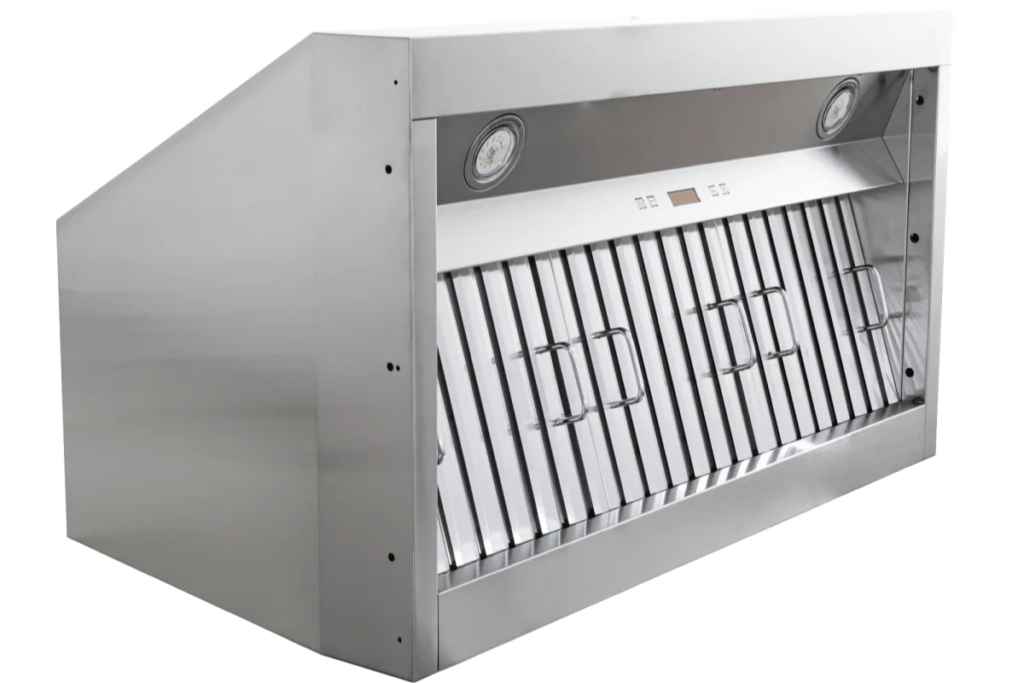
A 60” exhaust hood is designed for large cooktops and professional-style kitchen setups where high heat, grease, and smoke output require powerful ventilation. Unlike standard residential hoods, these wider 60” exhaust hood systems are built to provide full surface coverage across 48–60 inch ranges, ensuring that cooking fumes are captured efficiently before they spread into the kitchen. Industry insights show that proper hood sizing and airflow balance are critical because undersized or poorly matched ventilation systems can significantly reduce capture efficiency and increase indoor air pollution levels during cooking.
Understanding Airflow Capacity and CFM Requirements
The most important factor when selecting a 60” exhaust hood is airflow capacity, measured in CFM (cubic feet per minute). For large cooking surfaces, experts generally recommend a minimum of 900 CFM, with higher-end setups requiring 1,200 CFM or more, depending on cooking intensity and gas output. Heavy-duty cooking, such as grilling, frying, or wok cooking, produces higher heat and grease emissions, requiring stronger suction power to maintain air cleanliness.
However, real-world performance is not just about maximum CFM ratings. Duct length, bends, and vent quality can reduce effective airflow once installed. Longer duct runs, or multiple turns, can significantly decrease efficiency, meaning the hood must be selected with a performance buffer to compensate for system resistance. Proper airflow planning ensures that the 60” exhaust hood maintains consistent suction under real kitchen conditions.
Capture Area and Hood Design Efficiency
Capture efficiency is another key consideration when choosing a 60” exhaust hood. A wider hood provides better coverage over the cooking surface, but depth and canopy design are equally important. Deeper hoods with extended overhangs help trap rising smoke and grease more effectively before it escapes sideways.
Modern designs often incorporate baffle filters made from stainless steel, which improve grease separation while maintaining steady airflow. These filters are also more durable and easier to clean compared to mesh alternatives. A well-designed hood ensures balanced suction across the entire cooking surface, eliminating hot spots where smoke may otherwise escape.
Noise Levels and Motor Quality Considerations
While high airflow is essential, noise control is equally important for residential kitchens. A well-engineered 60” exhaust hood uses insulated motors, balanced fan blades, and optimized airflow pathways to reduce vibration and sound output. Noise levels are typically measured in sones or decibels, with quieter models designed to maintain performance without disrupting conversation or daily kitchen activity.
Premium systems often incorporate multi-speed or variable-speed motors, allowing users to adjust airflow based on cooking intensity. Lower speeds handle light simmering quietly, while higher speeds manage heavy smoke and steam when needed. This balance between power and acoustics is essential for long-term usability in open-plan homes.
Installation and Venting System Optimization
Proper installation plays a critical role in the effectiveness of any 60” exhaust hood. Ducted systems are generally more efficient than ductless alternatives because they expel air directly outside rather than recirculating it through filters. Straight and short duct runs maximize airflow efficiency, while excessive bends or undersized ducts reduce overall performance.
Correct mounting height is also essential. Installing the hood too high reduces capture efficiency, while placing it too low can interfere with cooking space and safety. Ensuring proper alignment with the cooktop improves smoke capture and ensures consistent ventilation performance over time.
Conclusion
Selecting the best 60” exhaust hood requires careful attention to airflow capacity, capture efficiency, noise control, and installation quality. A well-matched system not only improves kitchen air quality but also enhances cooking comfort and long-term appliance durability. For homeowners considering flexible ventilation solutions, options such as a ductless wall mount range hood may offer alternative installation possibilities in spaces where ducting is limited, although ducted systems typically provide stronger overall performance. With the right combination of power, design, and proper setup, a 60” exhaust hood becomes an essential component of a modern high-performance kitchen.
