


AI Recruitment Platform isn’t just a buzzword, it’s a strategic force redefining how companies discover, evaluate, and hire talent in 2026. For growing companies looking to scale quickly and sustainably, embracing AI-driven hiring isn’t simply an option anymore, it’s increasingly becoming a competitive necessity.
In today’s fast-paced talent landscape, businesses like yours can no longer rely solely on traditional methods. Platforms such as the one offered by Einstellen.AI empower teams, whether you’re a seasoned HR leader or building your first talent acquisition team, with AI-augmented efficiency that simple spreadsheets and manual workflows struggle to match. From empowering hiring teams on the employer side with automated insights to giving candidates a more streamlined experience through the candidate portal, AI is reshaping recruitment at every touchpoint.
But does that mean every growing company needs an AI Recruitment Platform? Let’s weave into a realistic narrative grounded in hard numbers and practical implications.
The Hiring Challenge Facing Growing Companies
Imagine a mid-sized tech startup with explosive user growth and an urgent hiring mandate. They need developers, product managers, QA engineers… fast. But the job market is crowded, attention spans are short, and quality candidates are in high demand. Meanwhile, hiring teams are buried under hundreds (if not thousands) of resumes.
This scenario is not uncommon. According to industry reports, 87% of companies now use AI in their recruitment processes, with 67% of hiring leaders citing time savings as the primary benefit of adopting such technologies.
And the adoption curve is steep, other research highlights that 43% of organizations worldwide used AI for HR and recruiting tasks in 2025, up from just 26% the year prior, signalling a rapid acceleration in adoption.
For startups and scaling firms, these aren’t abstract trends, they are practical realities shaping how quickly and cost-effectively they can hire.
Why AI Recruitment Platforms Are Becoming Mission-Critical
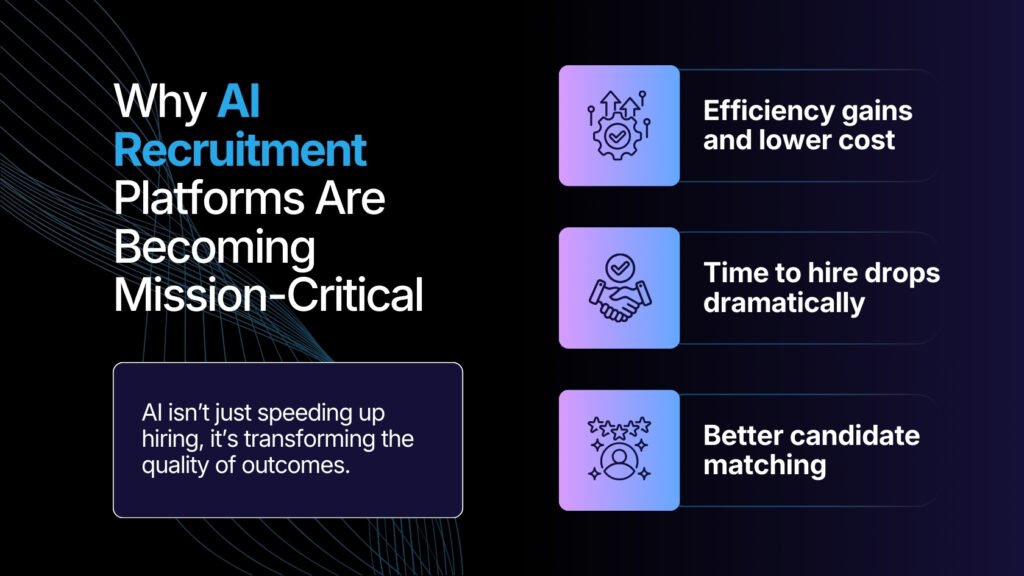
AI isn’t just speeding up hiring, it’s transforming the quality of outcomes.
Here’s what the data shows:
Efficiency gains and lower cost:
Nearly 75% of recruiters report that AI speeds up resume screening and candidate matching, while AI tools are automating up to 40% of repetitive hiring tasks, freeing recruiters to focus on strategic work.
Time to hire drops dramatically:
AI Recruiters can halve time-to-hire rates, meaning roles get filled faster with less friction and fewer bottlenecks.
Better candidate matching:
Predictive analytics improve candidate-job fit by up to 67%, reducing mismatches and improving retention.
In 2026, a newcomer to hiring automation like humAIn Advance, Einstellen.AI’s first fully autonomous interview agent, can transform how interviews are conducted, allowing companies to screen smarter and faster without overburdening human recruiters.
This isn’t just convenience; it’s a strategic weapon. Companies without automated systems risk being outpaced in a labor market where speed, accuracy, and candidate experience matter.
But Is AI Recruitment Platform Necessary for Every Growing Company?
Here’s where nuance matters.
he short answer? Not every company must adopt a full-blown AI Recruitment Platform immediately, but those who don’t risk falling behind.
Let’s break this down:
Early-stage startups may initially prioritize rapid product development over sophisticated HR tech. But as soon as the team grows beyond a handful of hires, manual processes become bottlenecks.
High-growth scaleups almost must have AI systems in place: jobs grow exponentially, candidate volumes scale, and efficiency becomes mission-critical to attract top talent.
Traditional businesses moving toward digital transformation face a choice: innovate with AI or risk attrition and slower hiring velocity.
Consider this analogy: You wouldn’t run a fast-growing e-commerce business without analytics and automation tools for inventory and orders. In 2026, an AI Recruitment Platform plays a similar role, for talent pipelines.
Every organization’s hiring maturity curve is different, but here’s what industry data suggests:
- 43-87% of companies already using AI in hiring.
- Nearly 75% of AI adopters cite efficiency gains.
- Predictive analytics and smart automation aren’t future-tech, they’re current-tech adopted by leaders.
This means adoption isn’t a “nice-to-have”, it’s a strategic benchmark for competitiveness.
Human + Machine: The Best of Both Worlds
Despite the powerful advantages, hybrid approaches still matter. According to a recent review, while AI tools are widespread, 93% of hiring managers emphasize that human insight remains vital in the hiring process.
That’s where AI platforms shine, not by replacing humans, but augmenting them. Automated screening, intelligent interview agents, and analytics take the grunt work off teams’ plates, while human recruiters focus on culture fit, negotiation, and strategic decisions.
It’s the best of both world, precision and empathy, built into workflows for employers and candidates alike.
Final Takeaway
In 2026, an AI Recruitment Platform is no longer a futuristic perk, it’s a key enabler for growing companies seeking talent at scale.
You don’t adopt it just because it’s trendy, you adopt it because it addresses real bottlenecks:
- Faster hiring cycles
- Better candidate experience
- Less bias and more data-driven decisions
- Competitive edge in the war for talent
Whether you’re exploring tools on Einstellen.AI or implementing innovations like humAIn Advance, the narrative is clear: AI-powered hiring is reshaping growth trajectories. The companies that embrace it now will define industry leadership tomorrow.
