


In today’s volatile global marketplace, relying solely on low cost country sourcing is no longer a sustainable competitive strategy. For years, organizations chased the lowest unit price, often moving production to whichever geography promised the cheapest labor. While this approach delivered short-term savings, it frequently introduced hidden costs—quality failures, long lead times, supply disruptions, compliance issues, and geopolitical exposure.
As global supply chains face rising labor expenses, logistics bottlenecks, trade uncertainties, and growing sustainability pressures, procurement leaders are rethinking their approach. This shift has given rise to Best Cost Country (BBC) Sourcing—a smarter, more balanced way to evaluate sourcing decisions based on total value rather than price alone.
What is Best Cost Country Sourcing?
Best Cost Country Sourcing is a strategic procurement approach that identifies sourcing locations offering the optimal balance of cost, capability, quality, risk, and strategic fit. Instead of asking, “Where can we produce this at the lowest cost?” organizations ask, “Which country provides the best overall value for this category?”
This approach recognizes that the cheapest option is not always the most economical in the long run. It moves the focus from price per unit to Total Cost of Ownership (TCO) and long-term resilience.
Core Pillars of a Best Cost Country Sourcing Strategy
A well-designed best cost country sourcing strategy rests on four key dimensions:
1. Total Cost of Ownership (TCO)
TCO goes beyond the supplier’s quoted price. It includes:
- Labor and raw material costs
- Utilities and overhead
- Freight and inland logistics
- Duties and tariffs
- Inventory carrying costs
- Quality-related expenses (rework, scrap, warranty claims)
- After-sales support and service costs
For example, sourcing from a distant low-wage country may appear attractive initially. However, higher freight rates, longer transit times, buffer inventory requirements, and rework costs can quickly erode the savings.
2. Supplier Performance and Capabilities
Reliable supplier performance is central to Best Cost Country Sourcing. Key considerations include:
- Consistent quality standards
- Engineering and technical capability
- Production scalability
- Flexibility during demand fluctuations
- On-time delivery performance
- Lead time reliability
A supplier with slightly higher pricing but superior process control and engineering capability may deliver significantly better long-term value.
3. Country and Location Risk
Macroeconomic and geopolitical factors can dramatically affect supply chain stability. A best cost country sourcing strategy must evaluate:
- Political and regulatory stability
- Currency volatility
- Trade agreements and tariff exposure
- Infrastructure quality (ports, roads, rail, digital systems)
- Ease of doing business
- Cultural alignment and communication capability
The COVID-19 pandemic and recent geopolitical tensions have highlighted the vulnerability of overly concentrated supply chains. Diversification and risk assessment are now critical components of sourcing decisions.
4. Strategic Alignment
Sourcing should align with broader business objectives. Questions to consider include:
- Does the location support innovation goals?
- Does it enable faster speed to market?
- Is proximity to key customer markets important?
- Does it meet ESG and sustainability requirements?
- Can it support future expansion plans?
Best Cost Country Sourcing is not purely a cost exercise—it is a strategic decision that influences competitiveness and resilience.
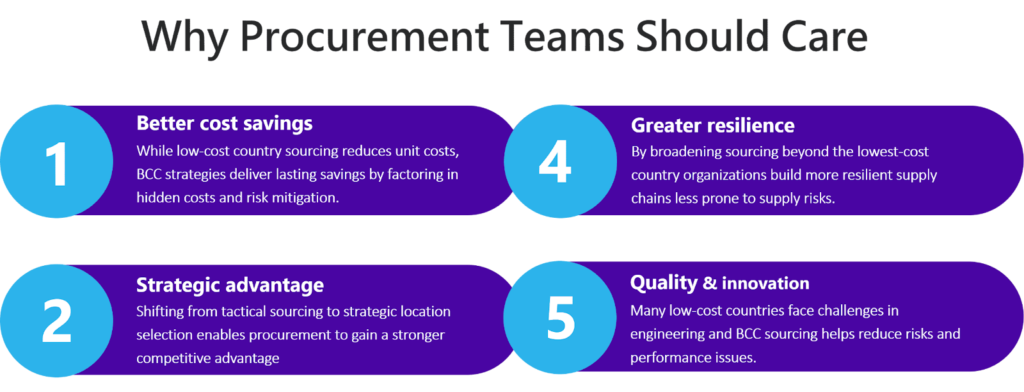
Why Procurement Teams Should Prioritize Best Cost Country Sourcing
Procurement functions have evolved from transactional cost managers to strategic value creators. A well-executed Best Cost Country Sourcing initiative can:
- Reduce total procurement costs sustainably
- Improve supply chain resilience
- Enhance quality performance
- Strengthen supplier collaboration
- Support ESG and compliance goals
- Mitigate geopolitical and currency risks
In today’s environment, procurement teams must balance savings with stability. The traditional model of low cost country sourcing alone no longer guarantees competitive advantage.
Key Steps in Implementing a Best Cost Country Sourcing Strategy
1. Define Category Requirements Clearly
Every category has unique requirements. For each spend area—whether components, raw materials, or services—organizations should define:
- Target cost levels
- Quality and compliance standards
- Lead time requirements
- Innovation needs
- Geographic limitations
- Sustainability expectations
- Supplier development priorities
Different categories may require different best cost geographies. For example, labor-intensive components may favor one region, while technically complex products may demand another.
2. Develop a Structured Country Evaluation Framework
A data-driven evaluation framework is essential. This should assess:
- Labor and material costs
- Utility and infrastructure expenses
- Freight and inland transport costs
- Tariff and trade implications
- Currency exposure
- Inventory requirements
- Quality and rework risks
Quantifying these elements allows procurement leaders to compare locations objectively rather than relying on assumptions.
3. Shortlist Suppliers and Assess Capabilities
Once promising geographies are identified, the next step involves mapping the supplier ecosystem:
- Number of capable suppliers
- Industry cluster maturity
- Certifications and compliance levels
- Backup suppliers to avoid single-source risk
- Financial health and capacity
Factory audits, product sampling, and technical capability assessments are critical during this stage. Digital audit tools and risk management platforms can further strengthen supplier evaluation.
4. Plan Transition and Governance
Shifting to a new sourcing country requires careful change management:
- Phased transition planning
- Inventory buffer management
- Logistics realignment
- Stakeholder communication
- Performance monitoring
Strong governance ensures that projected savings and performance improvements are realized without operational disruptions.
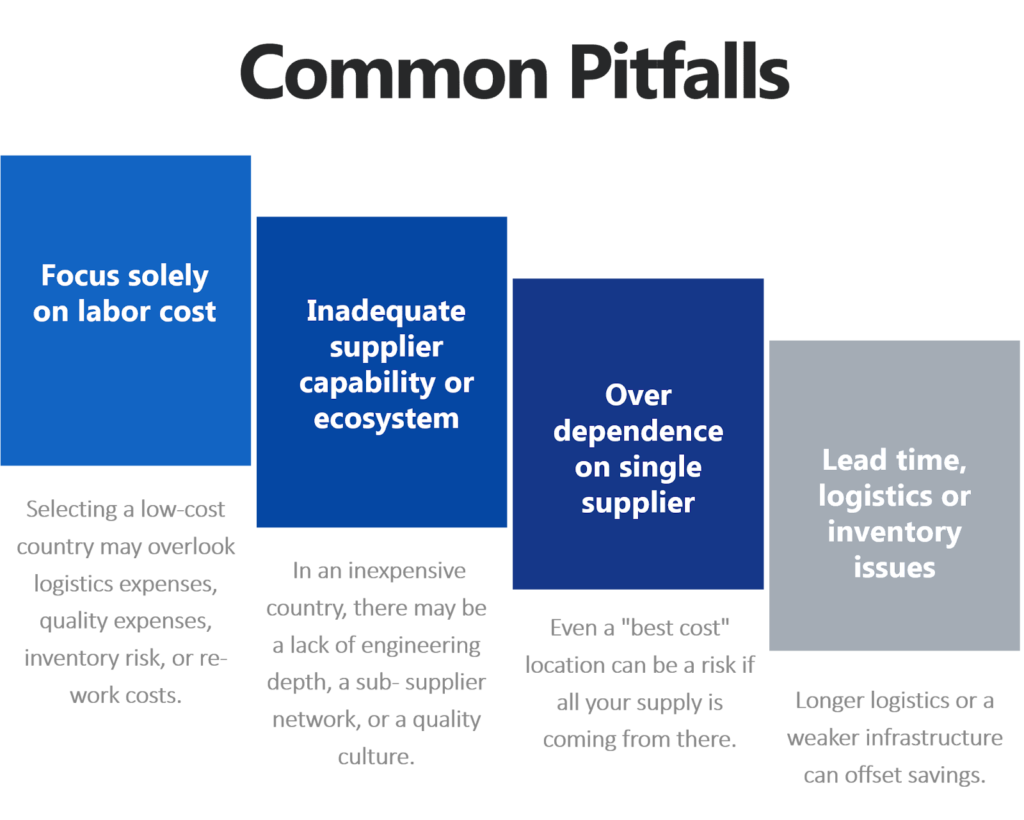
Common Pitfalls to Avoid
While Best Cost Country Sourcing delivers significant advantages, organizations must avoid common mistakes:
- Overemphasizing labor cost alone
- Ignoring hidden logistics and quality costs
- Failing to diversify suppliers
- Underestimating transition timelines
- Neglecting ESG and regulatory compliance
A rushed decision based purely on price can create long-term challenges that outweigh initial savings.
Relevance for Indian Procurement and Sourcing Teams
For procurement professionals in India and across Asia, Best Cost Country Sourcing carries unique significance.
India is increasingly positioned as a strong best-cost destination across multiple categories. With a skilled workforce, competitive operating costs, expanding infrastructure, and strong English-language capability, India offers a compelling value proposition for global buyers.
At the same time, companies are evaluating alternative geographies such as Vietnam, Malaysia, and Eastern Europe for category-specific advantages. Many global firms have adopted a “China + 1” approach to diversify risk while maintaining cost competitiveness.
For Indian companies supplying global markets, a best cost country sourcing strategy can help determine whether India remains the optimal location for specific categories or whether diversification enhances resilience and competitiveness.
Additionally, geographic proximity to Middle Eastern, African, and Asia-Pacific markets may strengthen India’s positioning in certain supply chains.
Best Cost Country Sourcing in Action
Consider a global manufacturer seeking to reduce production costs while diversifying its supply base. By forming a cross-functional team, evaluating multiple countries, qualifying new suppliers, and implementing structured governance, the company transitioned a substantial portion of its purchasing volume to optimized locations.
The result was not only significant annual savings but also enhanced resilience and reduced dependency on high-cost regions. This example demonstrates that Best Cost Country Sourcing delivers both financial and strategic benefits when executed systematically.
Related Blogs:-
A story of strategic discovery: How market intelligence services can help you grow
Market Intelligence Services: Your Compass in a Foggy Marketplace
Spend Data Classification: From a Messy Spreadsheet to a Strategic Goldmine
FAQs:-
1. What is Best Cost Country (BCC) Sourcing?
It is a sourcing strategy that selects countries based on total value—cost, quality, capability, and risk—rather than lowest price alone.
2. How is BCC different from Low Cost Country (LCC) sourcing?
LCC focuses mainly on lowest labor cost, while BCC evaluates Total Cost of Ownership (TCO) and long-term resilience.
3. Why is TCO important in sourcing decisions?
TCO includes hidden costs like logistics, tariffs, inventory, and quality issues, giving a complete cost picture.
4. What risks does BCC help reduce?
It helps mitigate geopolitical, supply chain, currency, compliance, and operational risks.
5. Why is BCC relevant today?
Rising labor costs, trade uncertainties, and sustainability pressures make value-based sourcing more strategic than price-only decisions.
Conclusion
The era of simple low cost country sourcing is fading. Today’s complex supply chain environment demands a broader, smarter perspective. Best Cost Country Sourcing enables organizations to balance cost efficiency with quality, resilience, strategic alignment, and long-term sustainability.
By adopting a structured best cost country sourcing strategy—grounded in data, risk assessment, supplier capability evaluation, and strong governance—procurement teams can move beyond short-term savings and create enduring competitive advantage.
Contact our analytics experts to schedule a consultation and uncover how we can accelerate your journey of becoming a data-driven organization.
