


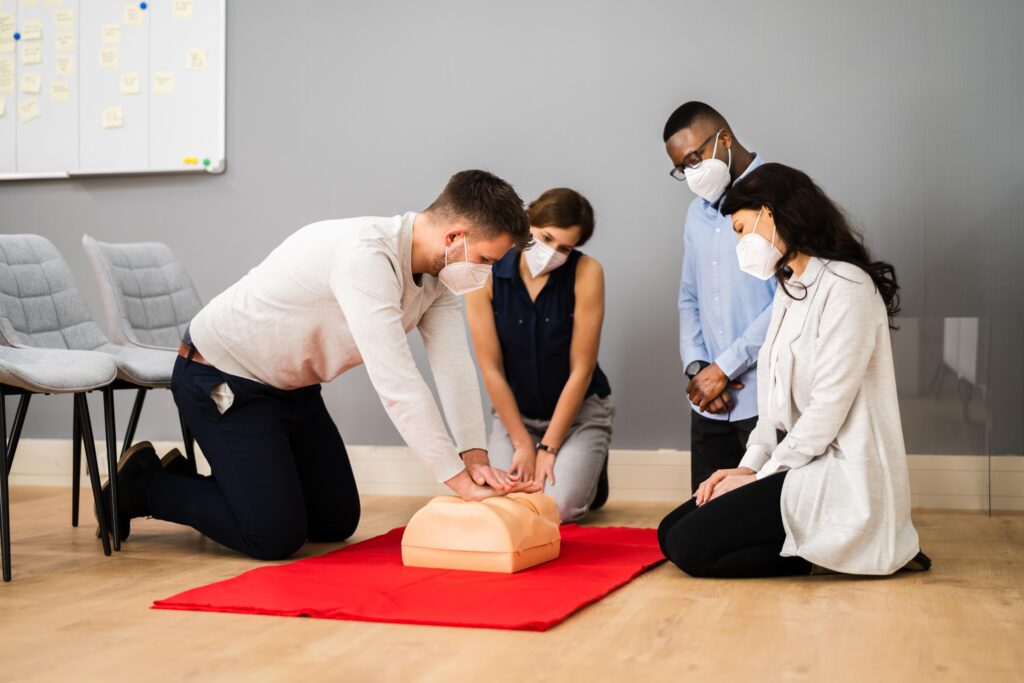
If you walk down memory lane, you’d find yourself playing doctor with your friends.
Do you remember how you gave your best to save a life — even if it was all a part of the play? The truth is, there’s an intrinsic drive in everyone’s heart to be of help to others.
Whether it’s a person starving, homeless, or in a critical health condition — the truth is, compassion goes a long way. By having a certification from a BLS CPR instructor course in Plano, your life-saving journey doesn’t just stop at dealing with OHCA cases — it goes beyond that.
In this, you don’t necessarily perform BLS CPR as a bystander emergency provider. Rather, you act as a trainer who helps aspiring CPR providers acquire life-saving skills. However, it does get confusing when you don’t know if you’re eligible enough to enroll in such a course.
Read below for more details.
What You Should Know About a BLS CPR Instructor Course in Plano
As it turns out, one doesn’t need to be a fictional hero to save lives in a cape. You can do a similar — and also a better — job at it by benefiting others with your BLS CPR skillset. That’s right, in a city as affluent yet dense as Plano (literally 4000 people per square mile), it’s necessary to prepare for any accident.
There can be a person down the street who just got electrocuted by a bare wire. Or one of your friend’s kids accidentally fell into the pool — not knowing how to swim. In all such hypothetical (yet very real) circumstances, it’s important to have as much support as you can.
If a community moves forward with the mission of saving lives — it surely has the potential to accomplish that goal. While not everyone may choose to become a BLS CPR instructor in Plano — many individuals certainly have the ability to do so.
Time to Dive Into the Details!
At trusted training clinics offering BLS CPR certification — such as CPR Training Clinic — you can enroll in a program aligned with the standards of the American Heart Association (AHA).
Here’s all you need to know about it.
- You have to complete the BLS Instructor Candidate Workbook.
- The training covers high-quality CPR for adults, children, and infants.
- Your training would also teach you to effectively utilize an AED machine.
- You’ll be required to work through effective team dynamics & handle pressure.
- You’ll be required to complete your initial training course on time.
- It will also be a requirement to utilize your teaching skills within the first 90 days after the completion of the BLS CPR instructor course in Plano — while being monitored by the training center’s faculty member.
- You’ll be required to affiliate yourself as an instructor with a recognized organization for gaining authority, support, and access to teach AHA courses — and be able to issue AHA course completion cards to others.
- Since instructor certificates typically expire every two years — you’ll have to renew the certificate to maintain credibility and continue teaching.
Who Is Eligible to Enroll in the Course of a BLS CPR Instructor?
The next big thing that aspiring BLS CPR instructors need to know is whether they are worthy of enrolling in such a course. Well, a word of advice. Don’t let doubt cloud your mind — let alone keep you from pursuing growth opportunities.
If you look at the crowd of BLS CPR providers on a conventional scale, you’ll find that not everyone remotely connects to the healthcare sector by their profession or academic background. To help you get a better view, spare a look at the table below:
| Factor | What’s Required? | |
| 1. | Age | At least 18 years of age (or more) |
| 2. | Status | Must hold an unexpired, valid AHA BLS Provider Card |
| 3. | Skills Proficiency | Must be proficient in all BLS skills (1 & 2 rescuer CPR, AED, bag-valve-mask, pocket masks, barrier devices, FBAO, and leadership → which would have been acquired in the prerequisite of a BLS CPR instructor course in Plano) |
| 4. | Instructor Essentials | Must complete the online BLS CPR Instructor Essentials Course |
| 5. | Training Center Affiliation | Must be affiliated with an AHA Training Center — which are open to accepting new instructors |
| 6. | Materials | Should have a BLS Instructor Manual and a BLS Provider Manual |
| 7. | For Medical Personnel | Paramedics, nurses, EMTs, doctors, physiotherapists, respiratory therapists, dental professionals, pharmacy personnel, clinical research staff |
| 8. | For Non-Medical Personnel | Personal trainers, fitness instructors, lifeguards, swim instructors, yoga fitness instructors, teachers, daycare providers, nannies, coaches, referees, security personnel, guards, police officers, jail staff, campus responders, construction workers, electricians, manufacturing staff, flight attendants, social workers, camp counselors, hospitality staff |
Did You Know?
According to the American Heart Association, immediate CPR can double or even triple a cardiac arrest victim’s chances of survival.
Gained Certification in This Course? Here’s How It Benefits You
Once you complete the BLS CPR instructor course, you don’t simply gain just another certificate. As you can imagine, the opportunities extend far beyond that threshold. When you become an instructor, you become a valuable part of the community by helping others learn how to respond during life-threatening emergencies.
Here’s a brief list of what you gain as you complete this course:
- You are eligible to teach life-saving skills to others in workplaces, schools, and community groups.
- If you work in healthcare, fitness, or safety training — this certification can add to your professional credibility.
- You get the opportunity to create an additional income stream by conducting CPR certification classes.
- Through hands-on teaching experience, you can build relationships and polish your communication skills.
- You can actively contribute to a safer community where more people are prepared for life-threatening emergencies — effectively bringing down mortality rates.
How a BLS CPR Instructor Course Differs from a CPR Provider One
Even though terms can cause confusion, diving a little bit into the details can help you tell the difference between a BLS CPR instructor course in Plano and a general CPR provider one.
A CPR provider course focuses on teaching individuals how to perform CPR and respond to emergencies first-hand. In this, the participants learn the fundamentals of chest compressions, rescue breaths, AED usage, and how to assist someone experiencing cardiac arrest or choking.
On the other hand, we have a course for a BLS CPR instructor — which goes one step further. Instead of just learning the skills, you learn how to pass the knowledge (and practice) to others. This involves the understanding of the following points:
- How to demonstrate CPR techniques
- How to guide students during hands-on practice
- How to assess the skill performance of participants during certification training
- How to lead team-based emergency response scenarios
To put it simply, one course prepares you to respond to emergencies, and the other one puts you in the position of training others to do the same.
Learn, Educate, and Save Lives Along the Way
Becoming a BLS CPR instructor is more than just earning another credential or a skill to make your resume appear stronger. In fact, it’s all about passing on knowledge that can make a real difference in critical moments.
Through trusted training providers like CPR Training Clinic, anyone can gain skills, confidence, and the authoritative stance to train others in performing life-saving techniques when time runs short. By enrolling in their BLS CPR instructor course in Plano, you take a step forward in strengthening your community’s emergency preparedness.
You see, the more people who know how to respond during a healthcare crisis, the greater the chances of saving lives.
Get more details on their website.
