


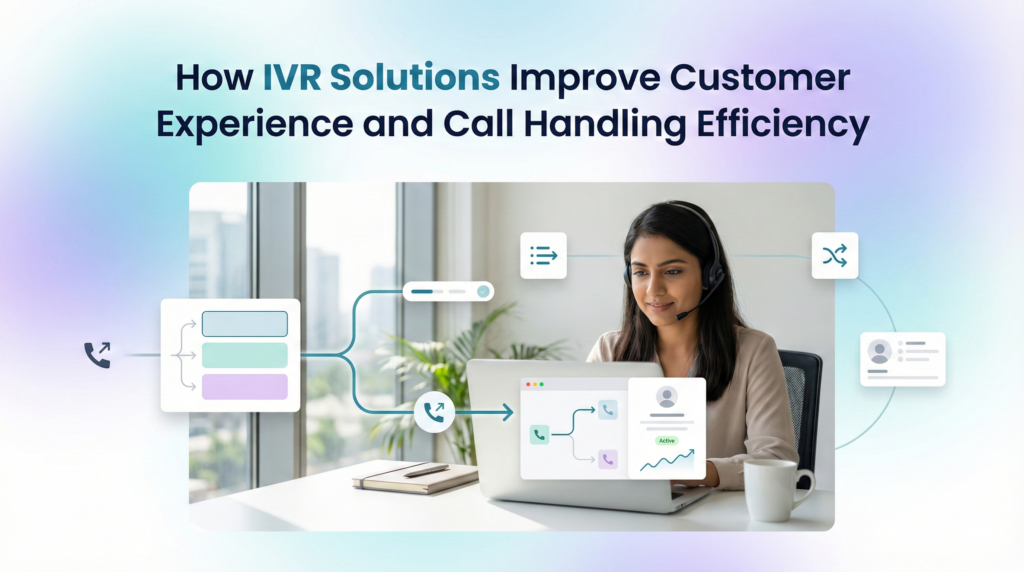
When customers call a business, they expect quick answers, minimal waiting, and a smooth experience from start to finish. Long hold times, repeated transfers, and confusing menus can quickly turn a simple query into frustration. This is where an IVR solution plays a crucial role in modern customer communication.
An IVR (Interactive Voice Response) system is more than just a call menu. It is a smart call handling system that guides customers, collects information, and routes calls efficiently. Businesses that invest in a well-designed IVR solution not only improve customer experience but also enhance operational efficiency across their support teams.
What Is an IVR Solution?
An IVR solution is an automated telephony system that interacts with callers through voice prompts and keypad inputs. It allows customers to select options, access information, or get routed to the right department without needing immediate human intervention.
Modern IVR solutions are often part of a cloud contact center platform. They integrate with CRM systems, call routing software, and analytics tools to create a seamless customer support environment.
Instead of acting as a barrier, a well-structured IVR solution becomes the first step toward faster and more personalized service.
Reducing Wait Times and Call Queues
One of the biggest challenges in customer support is managing high call volumes. When all calls are directed to agents without any filtering, queues become longer and wait times increase.
An IVR solution helps reduce this pressure by handling simple queries automatically. Customers can check account details, track orders, or get basic information without waiting for an agent. This reduces the number of calls that require human intervention.
By filtering and distributing calls efficiently, IVR systems ensure that agents are available for more complex issues, improving overall service speed.
Intelligent Call Routing for Faster Resolutions
A major advantage of an IVR solution is its ability to support intelligent call routing. Based on the caller’s input, the system directs the call to the most suitable agent or department.
For example, a customer selecting “technical support” is routed directly to a trained specialist instead of being transferred multiple times. This reduces frustration and improves first-call resolution rates.
Advanced IVR solutions can also use customer data, such as previous interactions or account status, to make smarter routing decisions. This ensures that customers are connected to the right person faster.
Enhancing Personalization
Customers expect personalized experiences, even in voice interactions. Modern IVR solutions integrate with CRM systems to identify callers and retrieve their history in real time.
When a known customer calls, the IVR solution can greet them by name, offer relevant options, or prioritize their request. Agents also receive this information through screen pop features, allowing them to continue the conversation without asking repetitive questions.
This level of personalization improves customer satisfaction and builds stronger relationships.
Improving Call Handling Efficiency
An IVR solution does more than improve customer experience. It also enhances internal efficiency.
By automating routine tasks such as call distribution, data collection, and initial query handling, IVR systems reduce the workload on agents. This allows teams to focus on high-value interactions instead of repetitive queries.
Call handling becomes more structured, with clear workflows and reduced manual intervention. As a result, businesses can handle higher call volumes without increasing team size.
Supporting 24/7 Availability
Customers expect support beyond standard business hours. Hiring round-the-clock staff can be costly and difficult to manage.
An IVR solution provides 24/7 availability by offering automated responses even when agents are offline. Customers can access information, leave messages, or request callbacks at any time.
This ensures continuous service and improves customer trust, especially for businesses operating across different time zones.
Reducing Operational Costs
Efficiency improvements naturally lead to cost savings. By reducing the number of calls handled by agents and optimizing call routing, IVR solutions lower operational expenses.
Businesses can manage higher call volumes without expanding their workforce. Cloud-based IVR solutions also eliminate the need for expensive hardware and maintenance.
For companies looking to scale support operations while controlling costs, an IVR solution offers a practical and effective approach.
Data Collection and Performance Insights
Modern IVR solutions provide valuable data that helps businesses improve their support processes. Metrics such as call volume, menu selection patterns, drop-off rates, and resolution times offer insights into customer behavior.
Managers can use this data to refine IVR menus, improve routing strategies, and identify common issues. Over time, this leads to a more efficient and customer-friendly system.
Analytics also help in measuring agent performance and overall call center efficiency.
Creating a Seamless Customer Journey
An effective IVR solution is not just about automation. It is about creating a smooth and intuitive journey for the customer.
Simple menu structures, clear voice prompts, and minimal steps ensure that callers can quickly find what they need. When combined with intelligent routing and CRM integration, IVR becomes a powerful tool for delivering consistent and high-quality support.
Businesses that focus on user-friendly IVR design see higher satisfaction rates and fewer abandoned calls.
Conclusion
Customer experience and operational efficiency are closely connected. Businesses that fail to manage calls effectively risk losing customers due to frustration and delays.
An IVR solution bridges this gap by automating call handling, improving routing accuracy, and reducing wait times. It empowers businesses to deliver faster, more personalized, and more reliable support.
In today’s competitive landscape, adopting a modern IVR solution is not just about technology. It is about creating better customer experiences while building a more efficient and scalable support system.
