


A customer reaches your checkout page. They are ready to pay. This is the most critical step in the buying journey. If your payment process is slow, confusing, or feels unsafe, the customer may leave without completing the purchase. A smooth and secure payment experience helps you convert more users into paying customers.
A payment gateway allows your website to accept online payments. It acts as a bridge between your customer, your website, and the bank. It handles sensitive data and ensures that every transaction is processed safely. Without a proper gateway, you cannot run a successful online store.
What happens during a payment
Here is what happens behind the scenes:
The user enters payment details
The gateway encrypts the data
It sends the request to the bank
The bank approves or declines the payment
The result is sent back to your website
This entire process takes only a few seconds. It ensures that payments are fast and secure.
Why payment gateway integration matters
Payment integration is not just a technical setup. It directly affects your business performance. A smooth checkout reduces cart abandonment. It also builds trust with your customers. When users feel that their payment is safe, they are more likely to complete the purchase.
A good payment system also supports multiple payment options. This is important because different users prefer different methods. Some prefer cards, while others prefer UPI or wallets. Giving users the choice improves the overall experience.
Today, businesses are also using AI in E-commerce to improve the payment process. AI can detect fraud in real time. It can also suggest the most relevant payment options based on user behavior. This reduces friction and helps improve conversion rates.
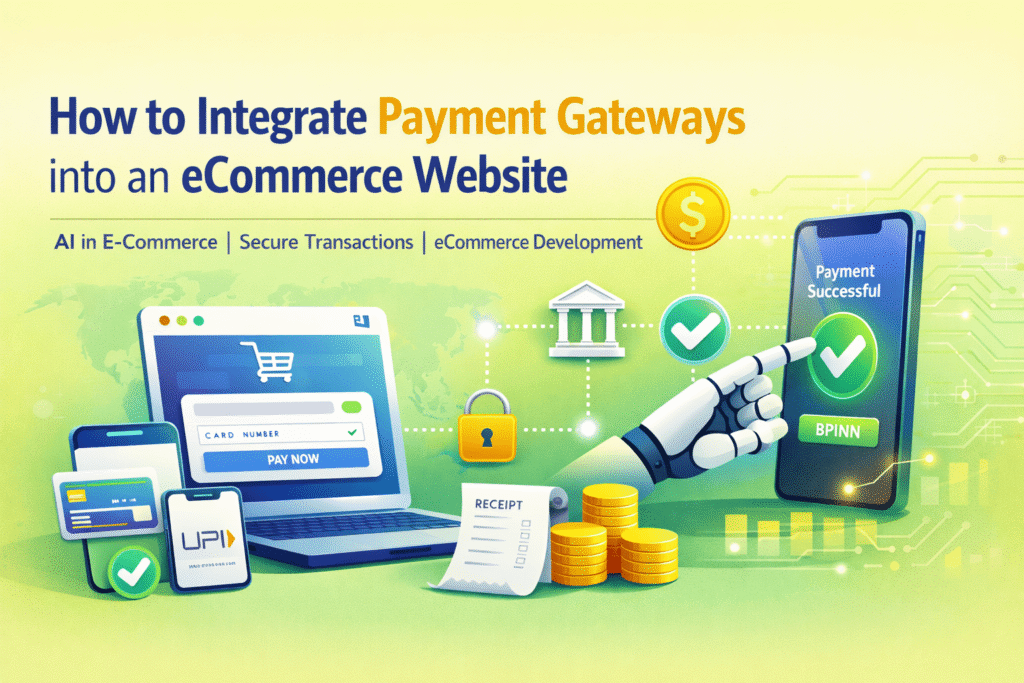
Types of payment gateway integration
Before you start, it is important to understand the different types of payment integration.
Hosted payment gateway
In this method, the user is redirected to a third-party payment page. The provider handles the transaction and security. This option is easy to set up and requires less technical effort. However, you have limited control over the design and user experience.
Self-hosted integration
In a self-hosted setup, the user enters payment details on your website. The data is then securely sent to the payment gateway for processing. This method gives you more control over the checkout design. At the same time, you need to handle security carefully.
API-based integration
This is the most advanced and flexible option. The entire payment process happens within your website. You can design a fully customized checkout experience. This method is ideal for growing businesses. It usually requires a skilled ecommerce developer to implement and manage it properly.
Steps to integrate a payment gateway
Choose the right payment gateway
The first step is to select the right provider. This decision affects your costs, performance, and user experience.
You should evaluate:
- Supported payment methods like UPI, cards, wallets
- Transaction fees and hidden charges
- Settlement time
- International payment support
- Ease of integration
For example, if your target audience is in India, UPI support is essential. Without it, you may lose potential customers.
Create a merchant account
After choosing a provider, you need to create a merchant account. This is required to start accepting payments.
You will need to:
- Submit business details
- Link your bank account
- Complete KYC verification
Once approved, you will receive API credentials such as a key and secret key. These are used to connect your website with the payment gateway.
Integrate the payment gateway
Now comes the core step. You need to connect the payment system to your website.
Your ecommerce developer will:
- Add the gateway SDK or APIs
- Connect the checkout page with the gateway
- Create a payment request when the user clicks the payment button
- Handle the response from the gateway
When a user makes a payment, the system processes the request and sends back the result. Your website must display the correct status and store transaction details properly.
Focus on security
Security is one of the most important parts of payment integration. You are handling sensitive user data, so you must protect it at every step.
Make sure you:
- Use HTTPS across your website
- Follow PCI-DSS compliance standards
- Encrypt all payment data
- Enable OTP or two-factor authentication
A secure checkout builds trust and reduces the risk of fraud.
Design a smooth checkout experience
A good payment system is not only secure but also easy to use. The checkout process should be simple and fast.
Focus on:
- Clear and simple layout
- Fewer steps to complete payment
- Mobile-friendly design
- Multiple payment options
- Fast loading speed
A clean checkout experience helps users complete their purchase without confusion.
Test the payment flow
Testing is a critical step before going live. It helps you find and fix issues early.
You should test:
- Successful transactions
- Failed payments
- Cancelled payments
- Refund process
- Performance on different devices
Most payment gateways provide a sandbox mode for testing. Use it properly before enabling live payments.
Go live and monitor
After testing, you can switch to live mode. Replace test API keys with live credentials. Start accepting real payments.
Once live, monitor your system closely. Track transaction success rates. Identify failed payments. Fix issues quickly to avoid revenue loss.
Role of AI in eCommerce payments
AI in E-commerce is making payment systems more advanced. It helps businesses improve both security and user experience.
AI can:
- Detect fraud in real time
- Analyze user behavior
- Suggest preferred payment methods
- Reduce payment failures
For example, if a user often uses UPI, the system can show it as the primary option. This reduces effort and speeds up the checkout process.
AI also helps in identifying unusual activity. This prevents fraud and protects both the business and the customer.
Common mistakes to avoid
Many businesses face issues during payment integration. These mistakes can affect your sales and user experience.
Some common mistakes include:
- Choosing a gateway that does not support local payment methods
- Ignoring mobile checkout optimization
- Skipping proper testing
- Poor handling of failed transactions
- Not offering enough payment options
Avoiding these mistakes can improve your payment success rate.
When to use professional services
As your business grows, payment integration becomes more complex. Managing everything in-house can be difficult.
This is where ecommerce website development services can help. They ensure that your payment system is secure, fast, and scalable. They can also help you integrate multiple gateways and optimize your checkout flow.
Working with experts saves time and reduces the risk of errors.
Final thoughts
Payment gateway integration is a key part of your eCommerce website. It directly affects how users complete their purchase. A fast and secure payment process builds trust and improves conversions.
Focus on choosing the right gateway, building a simple checkout flow, and ensuring strong security. Test everything before going live and monitor performance regularly.
When combined with AI in E-commerce, your payment system becomes smarter and more efficient. This helps you deliver a better user experience and grow your business consistently.
