



Introduction: A Growing Digital Risk in Healthcare
Healthcare is undergoing a rapid digital transformation. From electronic health records (EHRs) to telehealth and connected medical devices, technology has significantly improved patient care and operational efficiency. However, this digital shift has also made healthcare organizations prime targets for cybercriminals.
Sensitive patient data—ranging from personal identification to medical histories—is highly valuable, making healthcare systems vulnerable to ransomware attacks, data breaches, and phishing schemes. As cyber threats grow in complexity, traditional cybersecurity approaches are no longer sufficient. This is where Artificial Intelligence (AI) is emerging as a powerful ally.
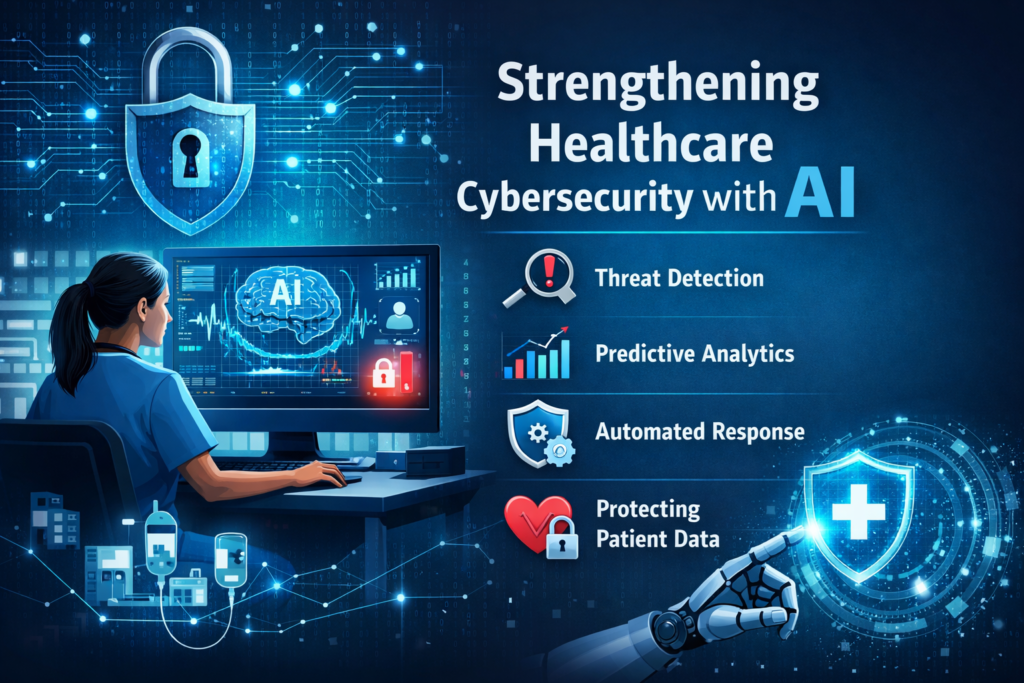
The Rising Threat of Cyberattacks in Healthcare
Cyberattacks in healthcare are not just increasing—they are becoming more sophisticated and costly. A single breach can disrupt hospital operations, delay treatments, and compromise patient safety. In some cases, entire healthcare networks have been forced offline due to ransomware attacks, affecting patient care across multiple facilities.
Financially, the impact is staggering. Healthcare consistently ranks among the most expensive industries for data breaches, with costs reaching millions per incident.
Beyond financial loss, these attacks erode patient trust and can have life-threatening consequences if critical systems are compromised.
Challenges Healthcare Organizations Face
Despite the urgency, many healthcare organizations struggle to defend against cyber threats effectively. Common challenges include:
- Limited cybersecurity infrastructure
- Lack of skilled IT and security professionals
- Inability to detect threats in real time
- Difficulty responding quickly to incidents
These gaps create opportunities for attackers to exploit vulnerabilities, often going undetected until significant damage has occurred.
AI as a Game-Changer in Healthcare Cybersecurity
Artificial Intelligence (AI) is transforming how healthcare organizations approach cybersecurity. Unlike traditional systems that rely on predefined rules, AI systems continuously learn, adapt, and evolve based on new data.
AI enables:
- Real-time monitoring of networks and systems
- Pattern recognition to identify unusual behavior
- Predictive analytics to anticipate potential threats
- Automated responses to mitigate attacks instantly
By analyzing large volumes of data, AI can detect anomalies that might go unnoticed by human analysts or conventional tools.
Key Applications of AI in Healthcare Security
1. Threat Detection and Prevention
AI-powered systems monitor network traffic 24/7, identifying suspicious activities such as unauthorized access attempts or abnormal data transfers. These systems can flag potential threats early, reducing the likelihood of a successful attack.
2. Predictive Risk Analysis
Using historical data, AI can forecast vulnerabilities before they are exploited. This proactive approach allows healthcare organizations to strengthen defenses in advance rather than reacting after an incident occurs.
3. Automated Incident Response
When a threat is detected, AI can take immediate action—such as isolating infected systems, initiating backups, or blocking malicious access. This rapid response minimizes downtime and prevents widespread damage.
4. Securing Medical Devices
With the rise of connected devices and the Internet of Medical Things (IoMT), AI plays a crucial role in protecting endpoints. It continuously monitors device behavior to ensure they are not compromised.
5. Protecting Patient Data
AI enhances data protection by strengthening encryption, monitoring access patterns, and ensuring only authorized users can retrieve sensitive information.
Technologies Powering AI Cybersecurity
Several advanced technologies work together to enable AI-driven cybersecurity:
- Machine Learning (ML): Learns from past data to identify threats and improve detection accuracy
- Deep Learning: Processes complex patterns and large datasets for advanced threat analysis
- Natural Language Processing (NLP): Helps analyze communication-based threats like phishing emails
- Big Data Analytics: Enables processing of massive healthcare datasets
- Cloud Computing: Provides scalable infrastructure for real-time monitoring and analysis
These technologies collectively create a robust defense system capable of adapting to evolving cyber threats.
Benefits of AI in Healthcare Cybersecurity
Implementing AI-driven cybersecurity offers several advantages:
Faster Threat Detection
AI reduces detection time from days or weeks to seconds, enabling immediate action.
Improved Accuracy
By minimizing false positives, AI allows security teams to focus on genuine threats.
Cost Efficiency
Preventing breaches reduces financial losses associated with data theft and system downtime.
Enhanced Compliance
AI helps organizations meet regulatory requirements by ensuring secure handling of patient data.
Scalability
AI systems can scale with growing data volumes and expanding healthcare networks.
Challenges of Implementing AI in Cybersecurity
While AI offers significant benefits, it is not without challenges:
- High implementation costs
- Need for skilled professionals
- Integration with legacy systems
- Potential for AI-driven cyberattacks
Healthcare organizations must carefully plan their AI strategies to maximize benefits while mitigating risks.
The Future of AI in Healthcare Security
As cyber threats continue to evolve, AI will play an increasingly critical role in healthcare cybersecurity. Future advancements may include:
- Self-learning security systems
- Fully automated threat response mechanisms
- Enhanced protection for telehealth platforms
- Stronger defense for AI-powered medical devices
The integration of AI into cybersecurity is not just a trend—it is becoming a necessity for modern healthcare systems.
Conclusion: Building a Secure Healthcare Ecosystem
Healthcare organizations are at a crossroads. The same technologies that improve patient care also introduce new vulnerabilities. To navigate this landscape, a proactive and intelligent approach to cybersecurity is essential.
Artificial Intelligence offers a powerful solution by enabling real-time monitoring, predictive threat detection, and automated response mechanisms. By adopting AI-driven cybersecurity strategies, healthcare providers can protect sensitive data, maintain patient trust, and ensure uninterrupted care delivery.
In an era where cyber threats are constantly evolving, AI provides the resilience and adaptability needed to stay one step ahead—safeguarding both healthcare systems and the lives they support.